
Updated for 2026 recruiting season
McKinsey Solve 2026: The Complete Overview
The McKinsey Solve assessment in 2026 decides who advances to a case interview — and over 60% of candidates don't make it. This is the definitive overview: how the test works, the 3 games you'll face, scoring, pass rates, and exactly how to prepare.
What is McKinsey Solve?
McKinsey Solve is a gamified online assessment used by McKinsey & Company to evaluate candidates' cognitive abilities during the recruitment process. The test features three timed games — Sea Wolf, Red Rock Study, and Sustainable Future Lab — measuring problem-solving, critical thinking, and decision-making skills.
Key Takeaways
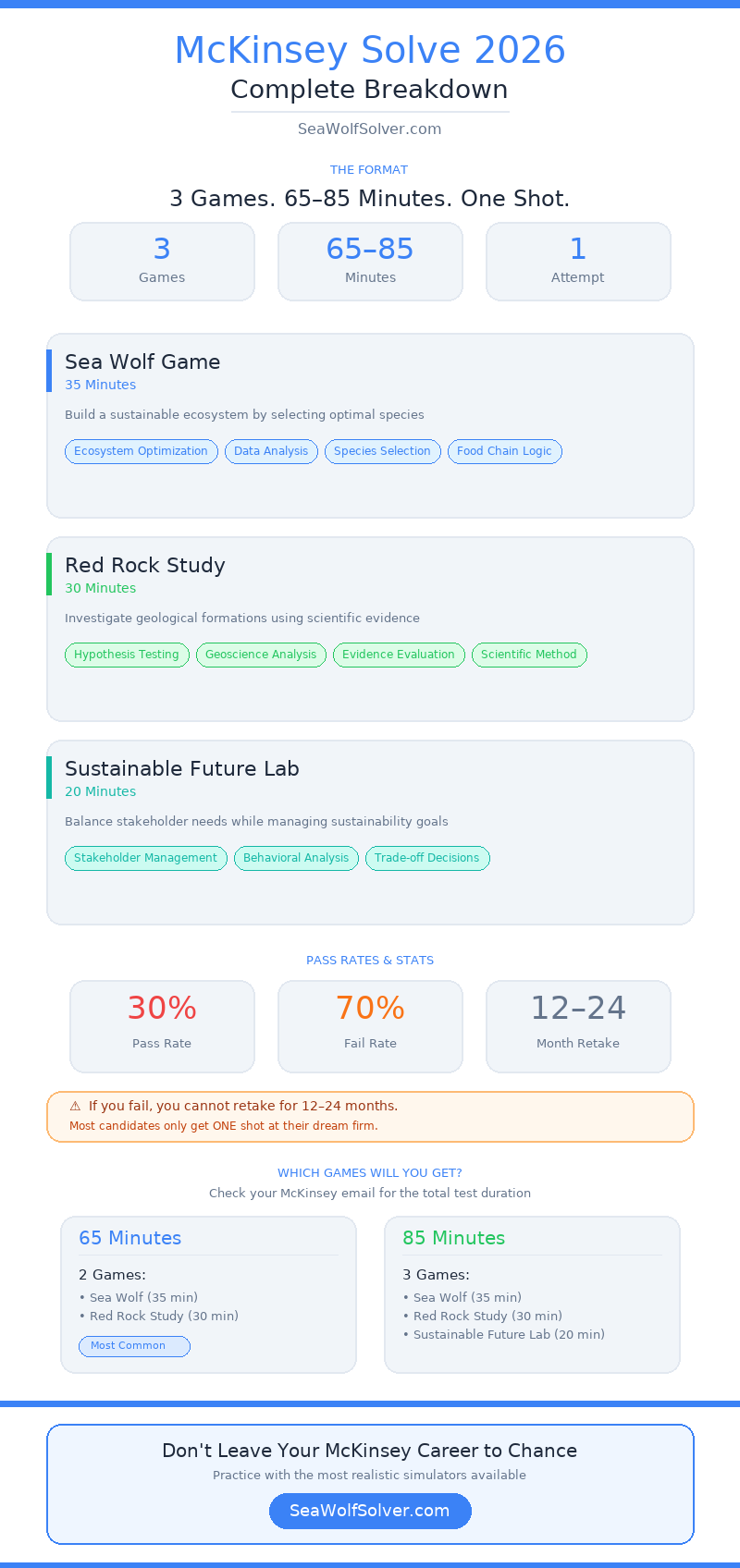
- McKinsey Solve is a 65–85 minute gamified assessment. The duration depends on your game combination: Sea Wolf (35 min) + Red Rock Study (30 min) = 65 min, or all three games including Sustainable Future Lab (20 min) = 85 min.
- The typical pass rate is ~30%, but candidates who practice with targeted tools pass at 3× the average rate.
- You cannot retake the test for 12–24 months — preparation is essential.
- The assessment tests critical reasoning, data interpretation, and systems thinking — not business knowledge.
- 3–5 days of focused practice is enough to significantly boost your score.
What Is McKinsey Solve?
The McKinsey Solve assessment — formerly known as "McKinsey Imbellus" (named after the original test platform provider, Imbellus) and also called the Problem Solving Game or Digital Assessment — is a gamified online test McKinsey uses worldwide as the first screening step after you submit your application. It replaced the old multiple-choice PST (Problem Solving Test) in most offices starting around 2020.
Instead of answering multiple-choice questions on paper, you solve interactive, game-like scenarios on your computer. McKinsey doesn't care whether you "win" the game — they measure how you think: how you structure problems, interpret data, optimize decisions, and manage complexity under time pressure. These are the same cognitive skills McKinsey consultants use daily with clients.
The assessment is administered by Imbellus (acquired by Roper Technologies). You'll receive a link via email after applying, with a deadline — typically 3–5 days — to complete it. The test is unsupervised (you take it at home), lasts about 65–85 minutes, and as of 2026, you play 3 games: Sea Wolf, Red Rock Study, and Sustainable Future Lab. Your score strongly influences whether you're invited to first-round case interviews.
Why This Matters
If you fail the Solve assessment, McKinsey imposes a 12–24 month cooldown before you can re-apply. For MBA candidates on a fixed recruiting timeline, that often means missing the cycle entirely. This is why targeted preparation with the right tools is not optional — it's essential.
How the McKinsey Solve Assessment Works
Here's exactly what happens from invitation to result:
You receive an email invitation
After submitting your McKinsey application, you'll get a link from Imbellus with a deadline (usually 3–5 days). You can take the test anytime within that window.
System check & setup
You'll run a quick browser compatibility check. The test requires a stable internet connection, a desktop/laptop (no tablets or phones), and a modern browser. No webcam or microphone is required.
Play the games
You'll play 3 games: Sea Wolf, Red Rock Study, and Sustainable Future Lab. Each game has its own instructions, tutorial, and timer. This is the standard format for the 2026 assessment.
Results are sent to McKinsey
You won't receive a score. McKinsey reviews your performance holistically across both games and decides whether to invite you to interviews. You'll hear back within 1–3 weeks.
The McKinsey Solve Games (2026 Format)
As of 2026, the McKinsey Solve assessment consists of three games: Sea Wolf, Red Rock Study, and Sustainable Future Lab. Each tests a different facet of problem-solving. Here's what to expect and how to prepare.
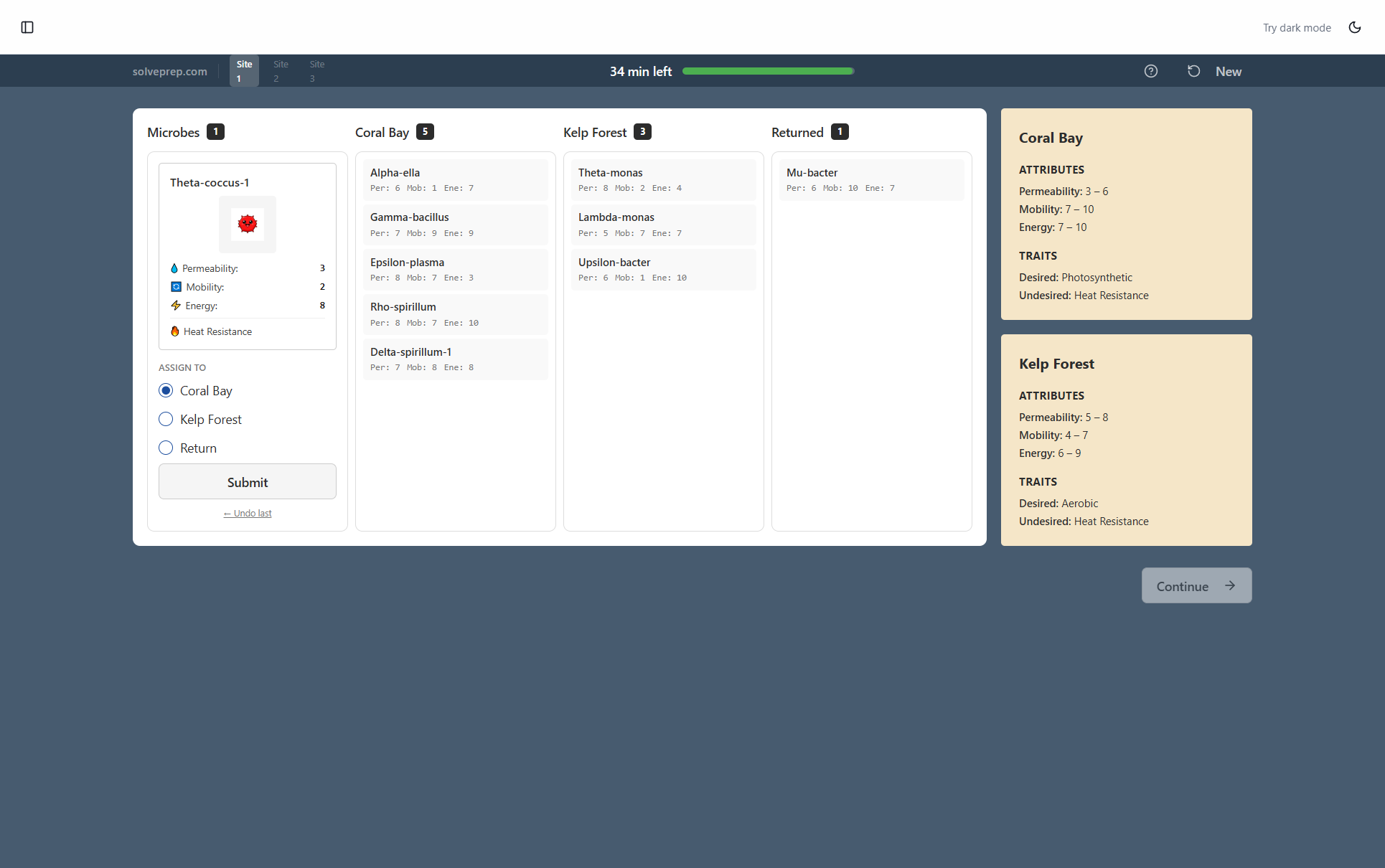
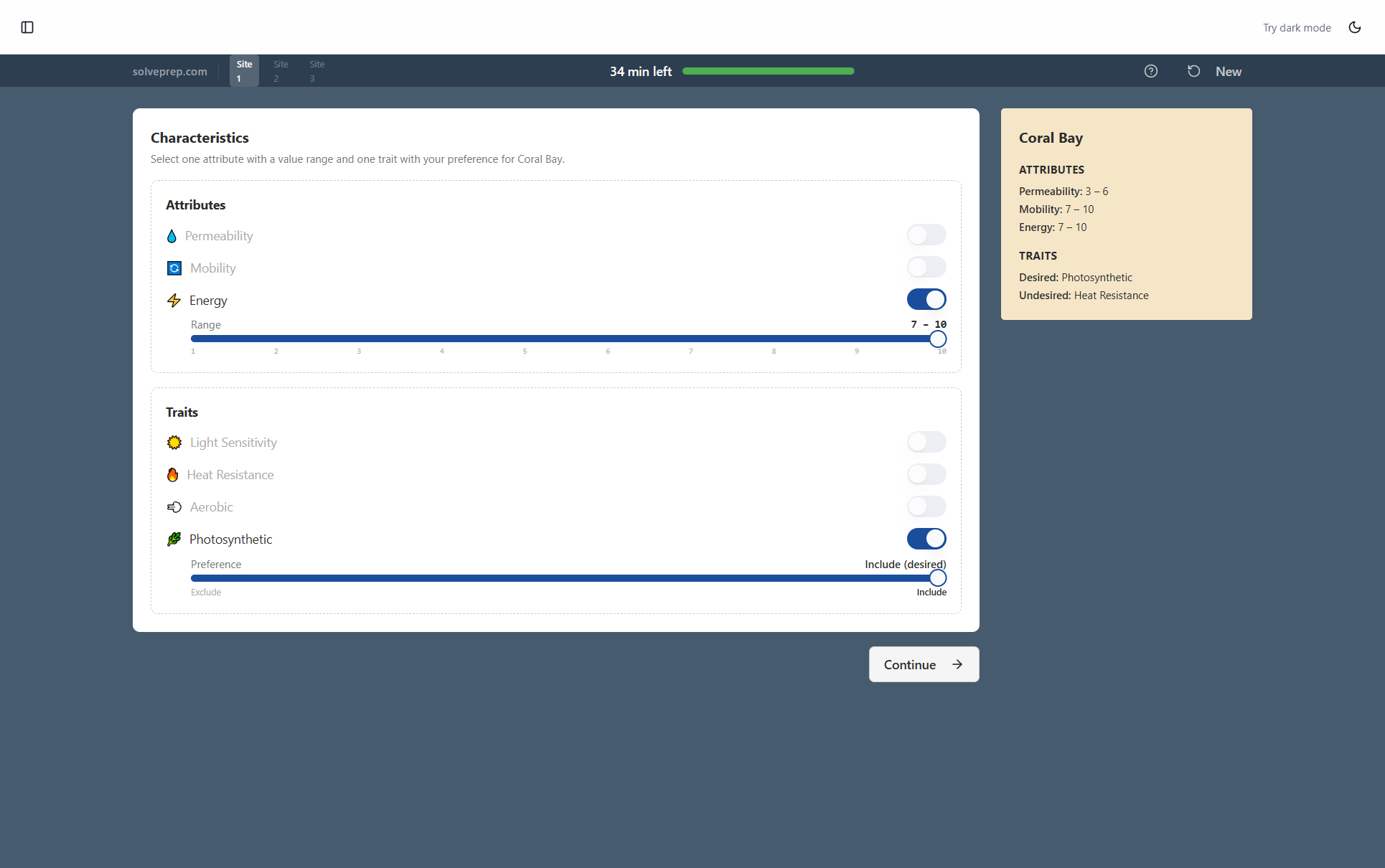
1. Sea Wolf Game (Microbe Optimization)
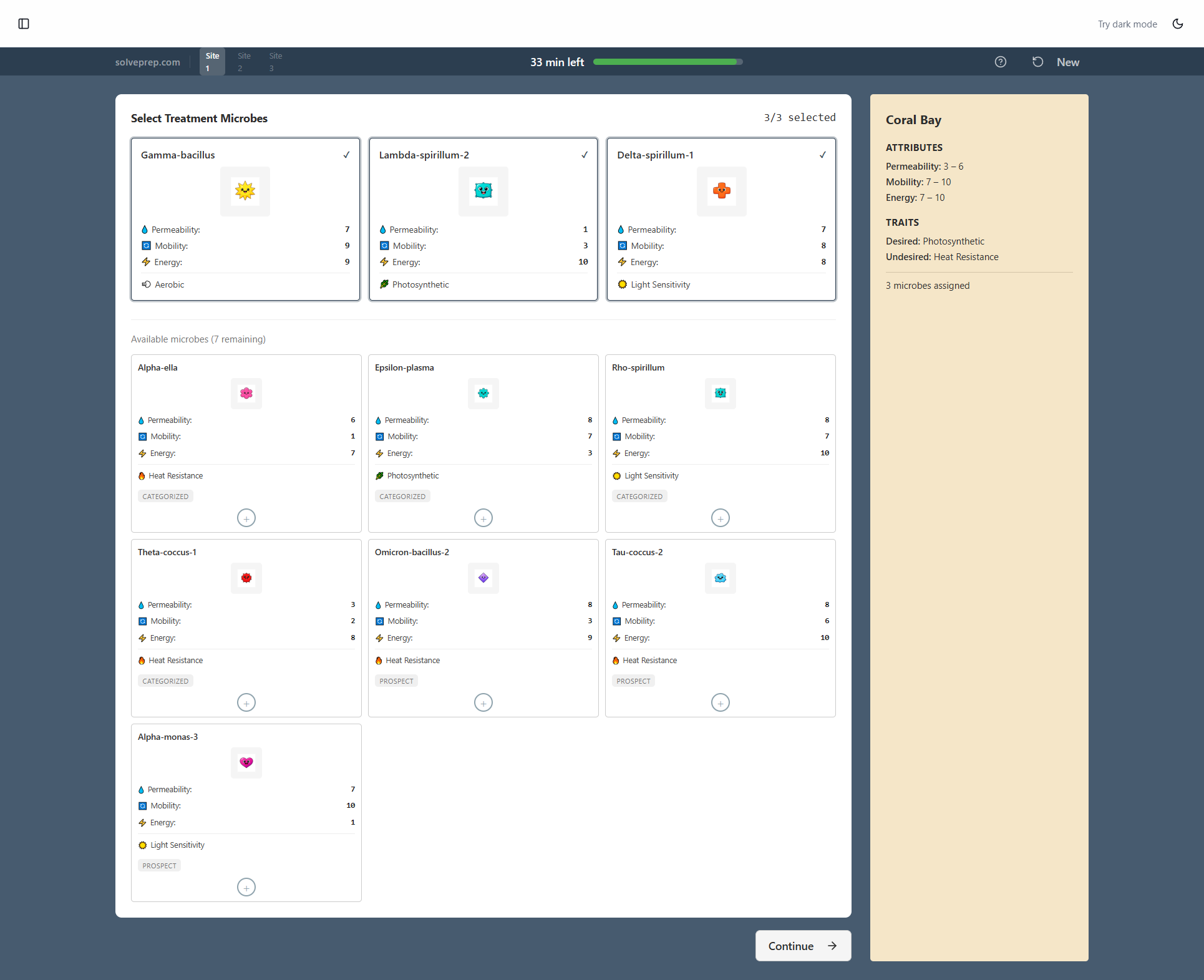
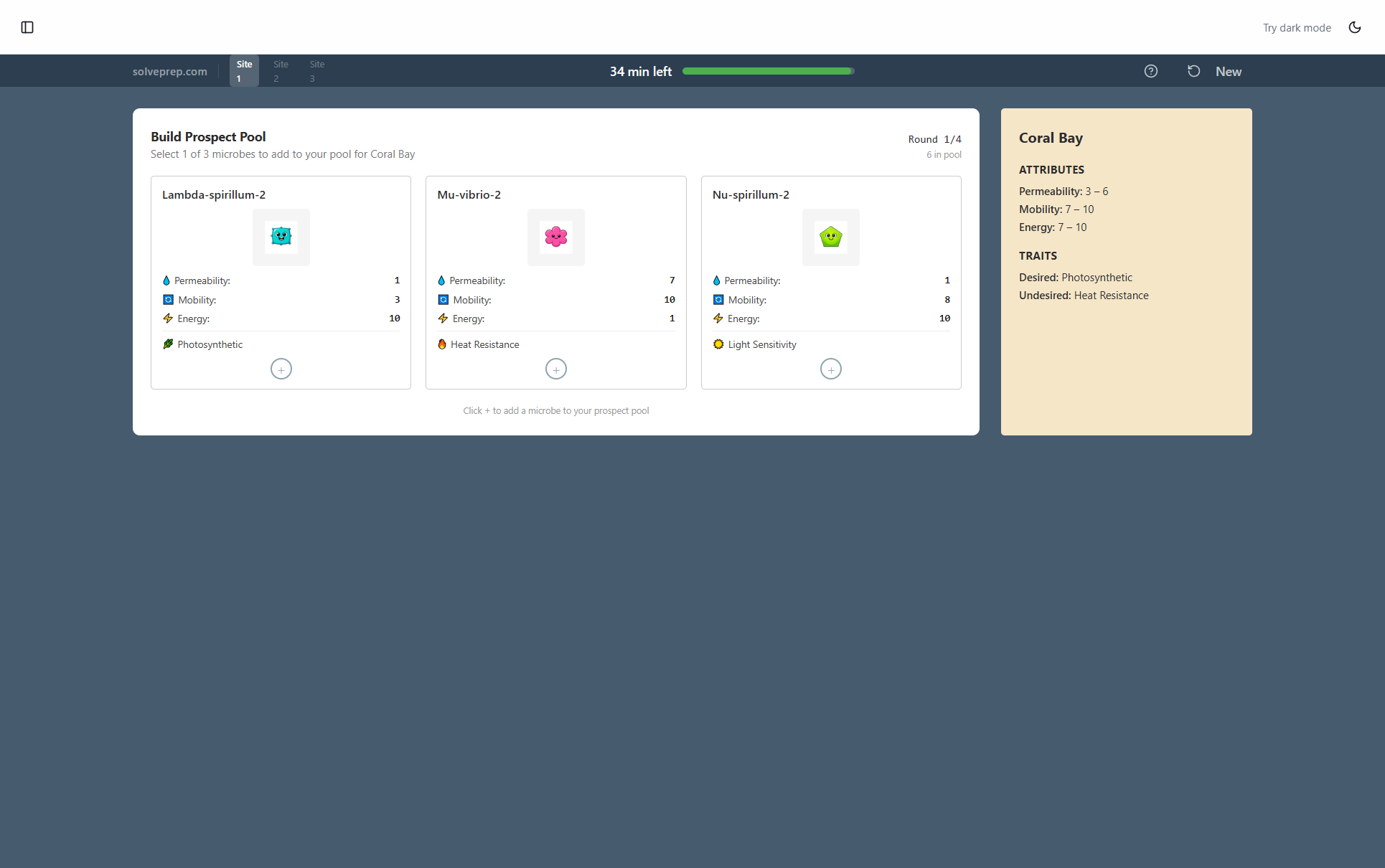
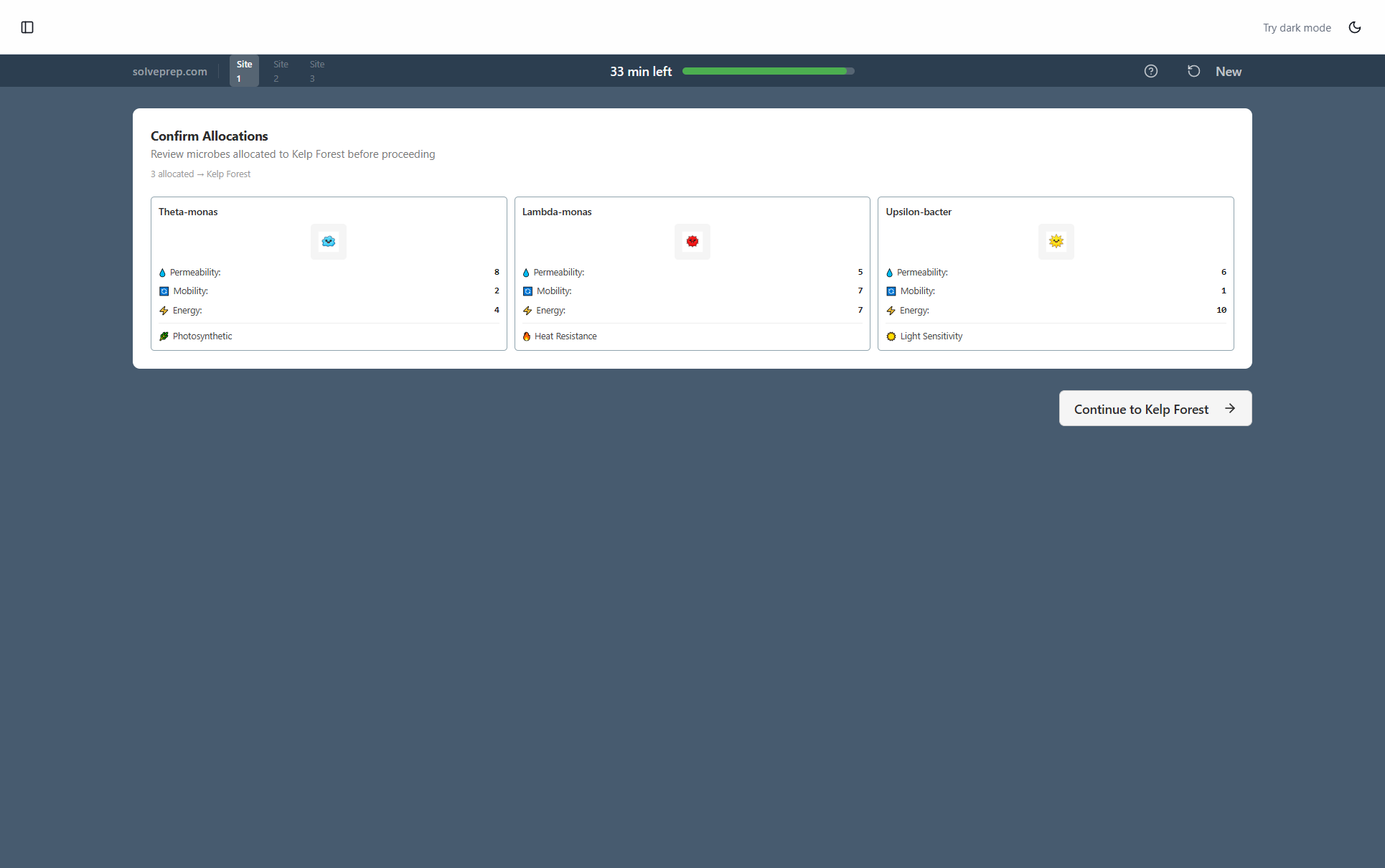
In the Sea Wolf Game, you're tasked with cleaning several polluted ocean sites by selecting combinations of microorganisms. Each microbe has unique properties: cleaning power, cost, toxicity, and environmental compatibility. Your goal is to choose optimal combinations that meet cleaning targets while respecting constraints like budget limits, toxicity caps, and coverage requirements.
This game heavily tests quantitative reasoning and optimization skills. You're essentially solving a constrained optimization problem under time pressure — the same kind of resource-allocation decisions McKinsey consultants make regularly. The challenge is that manual calculation is extremely slow, which is exactly why our Sea Wolf Excel Solver gives you a decisive edge.
Key strategies:
- Understand constraint types before selecting microbes — budget, toxicity, and coverage interact in non-obvious ways
- Prioritize high-efficiency microbes first, then fine-tune with smaller additions
- Use an Excel solver to practice realistic scenarios and build intuition for trade-offs
- Don't aim for perfection — aim for feasible solutions that satisfy all constraints
2. Red Rock Study (Research & Data Analysis)
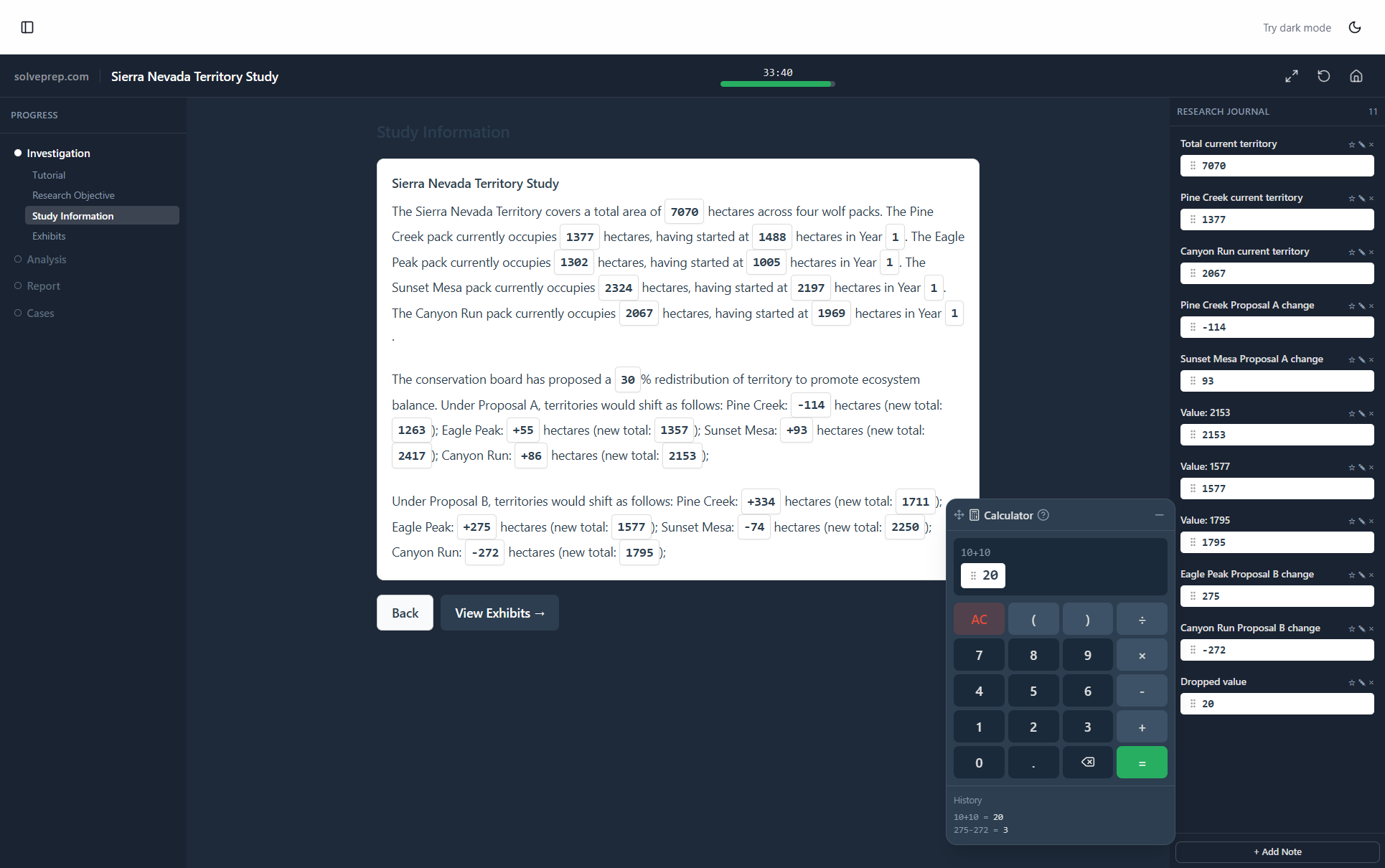
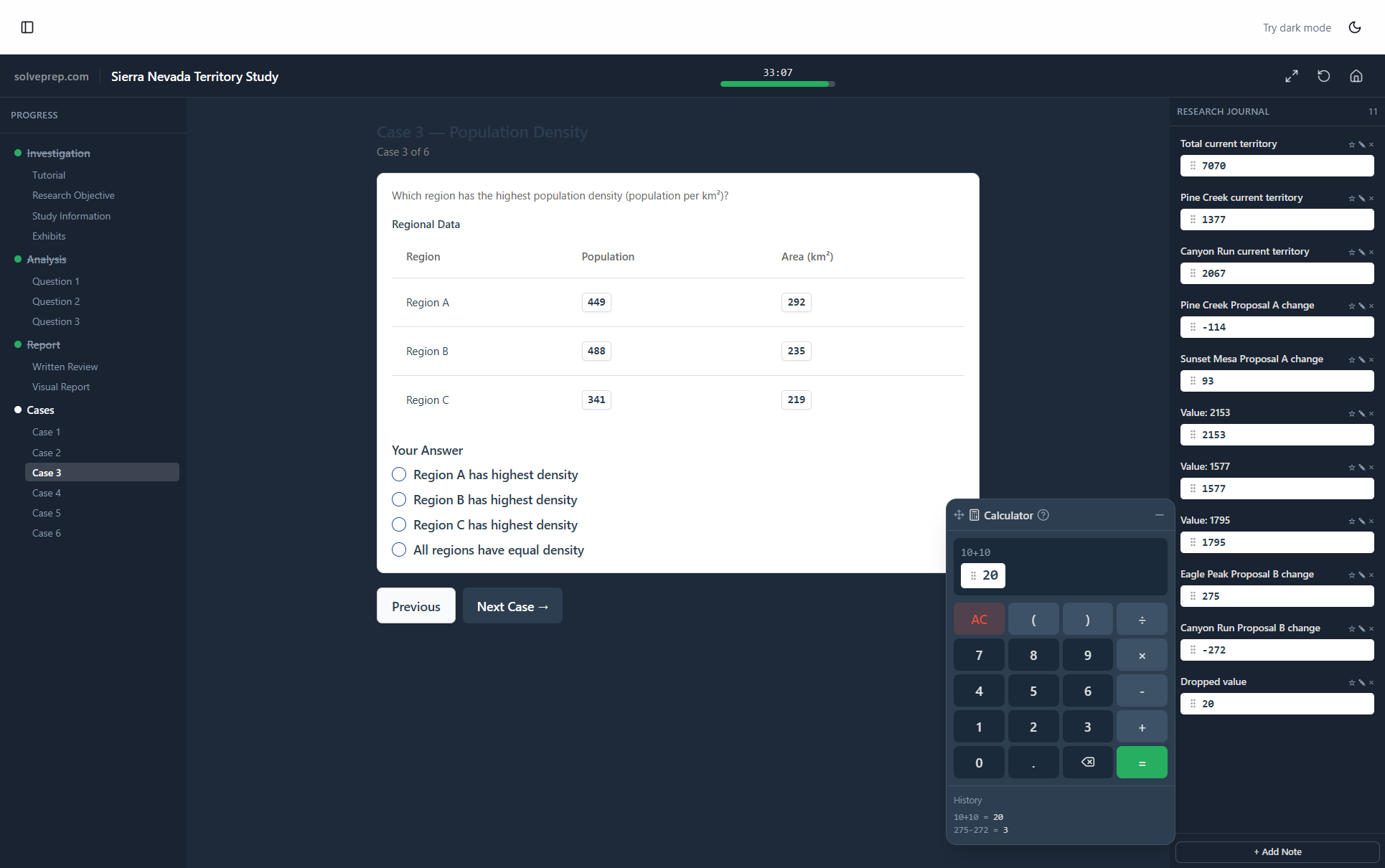
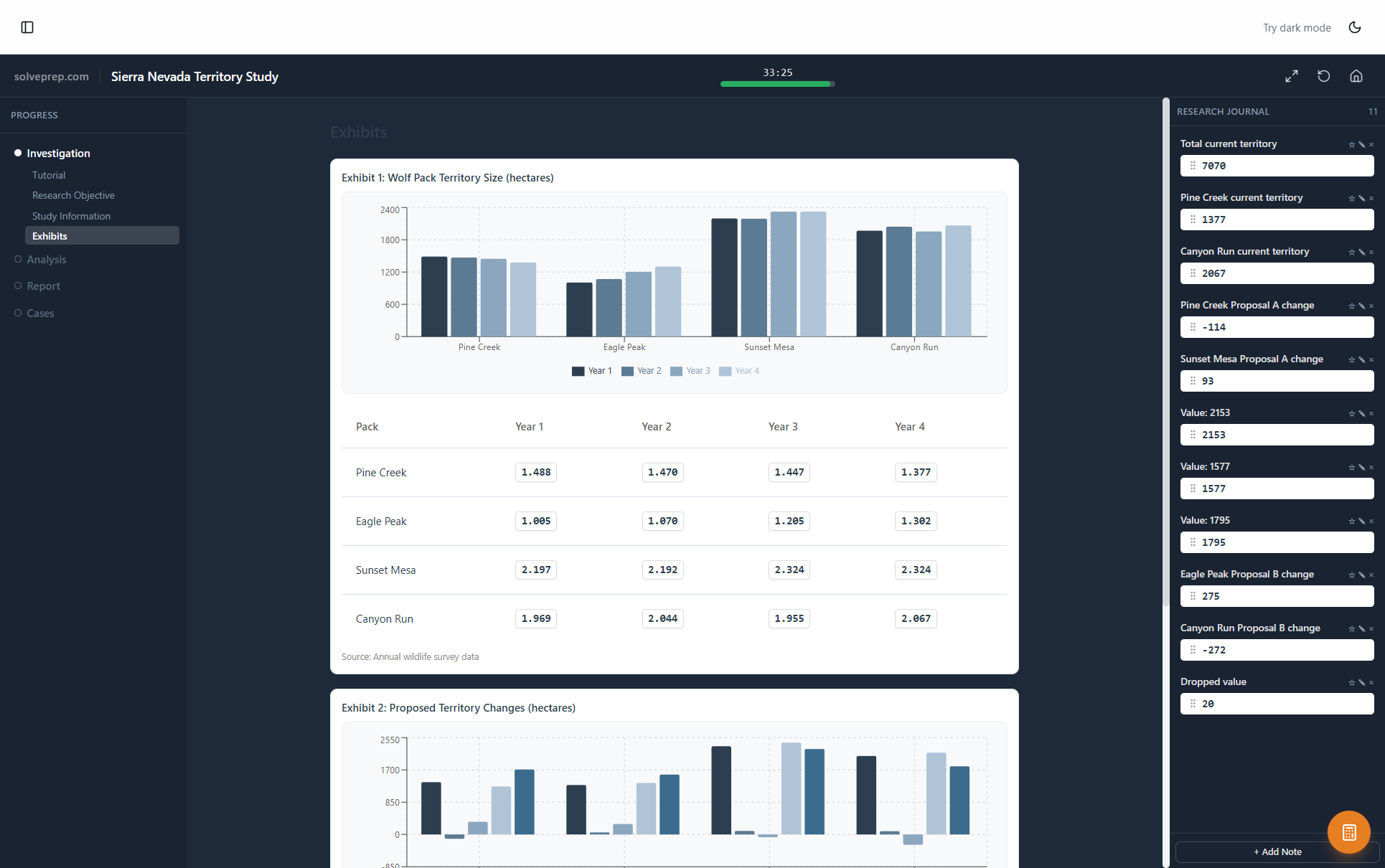
Red Rock Study presents you with a digital research journal about an ecosystem in the Red Rock region. You first study the journal — species data, environmental measurements, experimental results — and then answer a series of analytical questions. Each question requires you to interpret charts, compare data across tables, calculate percentages or ratios, and draw conclusions.
This game tests data interpretation, speed of mental math, and your ability to find relevant information quickly in a dense document. The hardest part isn't the math — it's navigating the journal fast enough to answer every question within the time limit. Our AI-powered Red Rock Simulator generates unlimited unique scenarios so you can build the speed and pattern recognition you need.
Key strategies:
- Spend the full study period absorbing the journal — knowing where data lives saves you time on questions
- Practice reading charts quickly: axis labels, units, trends, and outliers
- Use estimation over exact calculation when the answer choices are far apart
- Simulate under timed conditions repeatedly until navigating the journal becomes second nature
3. Sustainable Future Lab (Behavioral Decision-Making)
The Sustainable Future Lab is McKinsey's newest addition to the Solve assessment. Unlike the quantitative Sea Wolf game or the data-driven Red Rock Study, this is a behavioral game that evaluates how you navigate complex sustainability decisions with multiple stakeholders and competing priorities.
You'll face scenarios involving resource allocation, stakeholder management, and sustainability trade-offs. Each decision affects environmental impact, economic viability, and community well-being. McKinsey uses this game to assess how candidates think about complex, values-laden problems — the same skills needed for modern ESG and sustainability consulting engagements.
The game is structured in rounds. Each round presents a scenario — for example, whether to expand a factory that would create jobs but increase emissions, or invest in renewable infrastructure that costs more upfront but reduces long-term environmental damage. You allocate resources, choose policies, and respond to stakeholder feedback. Decisions compound: early choices constrain later options, so you can't simply optimize each round in isolation.
McKinsey isn't looking for "right" answers — there often aren't any. They evaluate whether your decisions are internally consistent, whether you weigh all stakeholder perspectives before deciding, and whether you demonstrate structured reasoning when facing ambiguity. This makes the Sustainable Future Lab especially relevant for candidates targeting ESG, sustainability, or public-sector consulting roles, where real engagements regularly involve conflicting stakeholder interests and no clear optimal solution.
Key strategies:
- Read all stakeholder perspectives before deciding — McKinsey tracks whether you consider all viewpoints
- Maintain decision consistency — changing your framework mid-game signals weak reasoning
- Balance short-term economic impact with long-term sustainability outcomes
- Don't ignore minority stakeholders — they carry weight in the scoring
- Practice with our Sustainable Future Lab Simulator to build familiarity with multi-variable trade-offs
- Budget your 20 minutes carefully — later scenarios are more complex and carry more weight
Ecosystem Game (Legacy)
The Ecosystem Game was part of the original McKinsey Solve format (2020–2025) but is no longer included in the standard 2026 assessment. We include it here for reference and for candidates who may encounter legacy versions.
In the Ecosystem Game, you design a stable food web in a chosen environment. You select plants, herbivores, and predators — each with specific habitat needs, calorie requirements, and reproductive rates — and connect them into a functioning ecosystem. After running simulations, you see which species survive or go extinct and iterate on your design.
This game tested systems thinking and hypothesis-driven problem solving. You had to balance energy flows through multiple trophic levels, understand carrying capacities, and anticipate cascading failures. See our detailed Ecosystem Game guide for species selection strategies and common pitfalls.
Key strategies (for reference):
- Start with producers (plants) that match the terrain, then add herbivores and predators in balance
- Ensure every species has at least two food sources to avoid single points of failure
- Watch calorie flow: predators at the top need massive calorie chains below them
- Iterate after each simulation — remove extinct species and rebalance
How to Know Which Games You'll Get
Not every candidate receives the same game combination. McKinsey assigns either two or three games based on the role and office. The key indicator is the total time stated in your McKinsey invitation email.
Sea Wolf Game
35 min
Red Rock Study
30 min
Sustainable Future Lab
20 min
All Possible Game Combinations
Game Combination Calculator
Enter the total assessment time from your McKinsey invitation email to find out which games you'll get.
What Skills Does McKinsey Solve Test?
McKinsey designed the Solve assessment to measure the cognitive abilities that predict success in consulting. Unlike a case interview that tests communication, the Solve test focuses purely on how your brain processes information. Each of the three games targets a specific combination of skills — here's exactly what's being evaluated and which game tests it:
Critical & Analytical Reasoning
Breaking down complex problems into logical components, identifying patterns, and drawing valid conclusions from incomplete information.
Tested in: Sea Wolf, Red Rock Study
Data Interpretation
Reading charts, tables, and graphs quickly and accurately. Comparing data points, spotting trends, and making calculations under time pressure.
Tested in: Red Rock Study
Decision-Making Under Constraints
Making optimal choices when faced with trade-offs, budget limits, and competing objectives — the essence of consulting problem-solving.
Tested in: Sea Wolf, Sustainable Future Lab
Systems Thinking
Understanding how changes in one part of a system affect the whole. Anticipating second-order effects and designing for stability.
Tested in: Sea Wolf, Sustainable Future Lab
Numerical Reasoning
Performing quick calculations, estimating percentages, and comparing quantitative trade-offs under time pressure without a calculator.
Tested in: Sea Wolf, Red Rock Study
Behavioral Judgment
Making consistent, well-reasoned decisions when facing ethical trade-offs and stakeholder conflicts with no single correct answer.
Tested in: Sustainable Future Lab
| Skill | Sea Wolf | Red Rock | SFL |
|---|---|---|---|
| Critical Reasoning | — | ||
| Data Interpretation | — | — | |
| Decision Under Constraints | — | ||
| Systems Thinking | — | ||
| Numerical Reasoning | — | ||
| Behavioral Judgment | — | — |
How to Prepare for McKinsey Solve
Most candidates get 3–5 days from invitation to deadline. Here's how to use that time effectively:
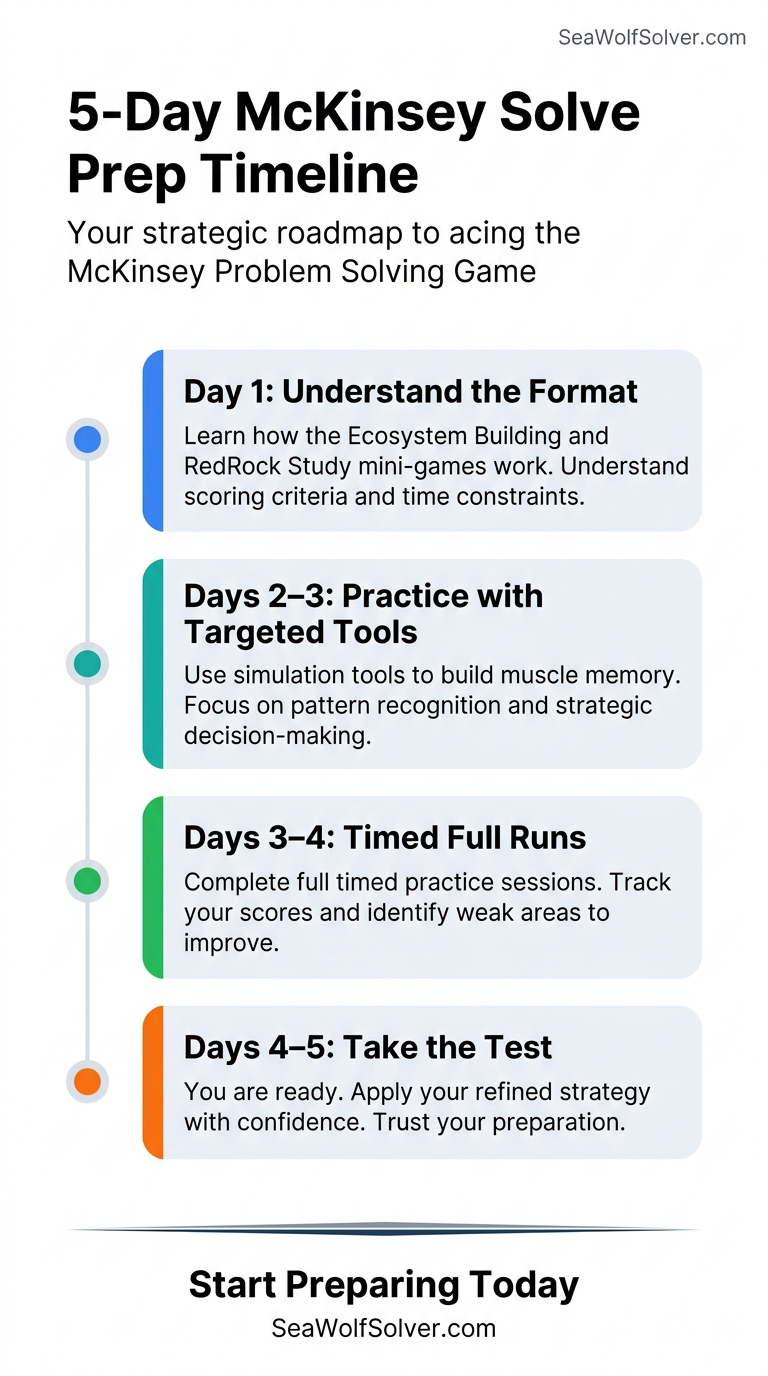
Understand the Format
Read this guide completely. Understand each game's mechanics, scoring, and time limits. Read our dedicated guides for Sea Wolf, Red Rock, and Sustainable Future Lab.
Practice with Targeted Tools
Use the Sea Wolf Excel Solver to practice optimization scenarios until you develop intuition for trade-offs. Run through our Red Rock Simulator and Sustainable Future Lab Simulator to build speed at interpreting charts, navigating research journals, and practicing behavioral decisions. Aim for at least 5–10 full practice rounds per game.
Timed Full Runs
Simulate test conditions: close all other tabs, set a timer, and complete full practice sessions without pausing. Review where you lost time and which question types tripped you up.
Take the Test
Choose a quiet environment, use a reliable computer and internet connection, and take the test when you feel mentally sharp — morning often works best. There's no penalty for completing early.
Preparation Tools That Give You an Edge
Built specifically for the McKinsey Solve assessment. Used by 900+ candidates from Harvard, Stanford, INSEAD, and more.
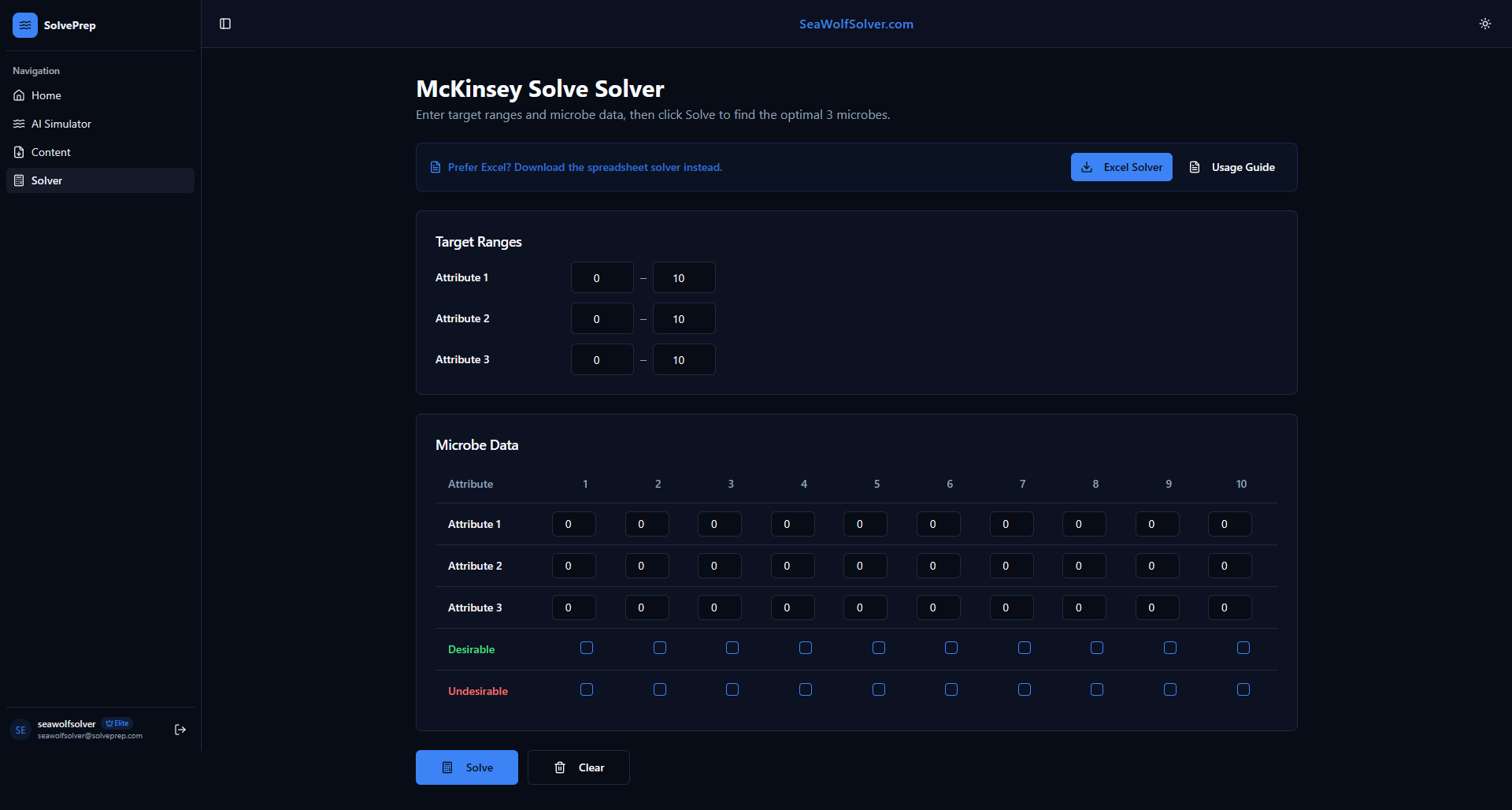
Sea Wolf Excel Solver
$29 one-time
- Instant optimal microbe selection for any scenario
- Practice 20+ realistic Sea Wolf problems
- Understand constraint interactions visually
- Step-by-step preparation guide included
- Lifetime access, no subscription
McKinsey Solve Elite Package
$79 one-time
- Sea Wolf Excel Solver + PDF Guide
- AI Solver Access (browser-based)
- Sea Wolf AI Simulator
- Red Rock Simulator
- Sustainable Future Lab SimulatorNEW
- Unlimited AI Scenarios
- Real-time Feedback
- Compare With Others
- Lifetime updates
30-day money-back guarantee. Instant delivery. No subscription.
McKinsey Solve Pass Rates & Scoring
McKinsey does not publish official pass rates or scoring thresholds. Based on candidate data and industry reports, here's what we know:
- The estimated pass rate is roughly 30%, meaning ~70% of candidates are eliminated at this stage.
- Your performance is compared against other candidates in the same applicant pool — it's a relative ranking, not an absolute score.
- McKinsey evaluates your performance holistically across both games, not just on a single game.
- There is no known minimum score. Some candidates have passed with strong performance on one game and average on another.
- Process-based metrics (how you approach problems) may matter as much as outcome-based metrics (whether you got the right answer).
Bottom line: You can't game the scoring algorithm, but you can maximize your performance by deeply understanding each game's mechanics and practicing with realistic tools. That's what separates candidates who pass from those who don't.
Can You Retake McKinsey Solve?
Yes, but with significant restrictions. McKinsey typically enforces a 12–24 month waiting period before you can retake the Solve assessment. The exact cooldown varies by:
- Office: Some offices have stricter policies than others.
- Role: Experienced hire vs. campus recruit timelines differ.
- Performance: In rare cases, very strong overall applications with a borderline Solve score may get a second chance sooner.
For MBA candidates on a fixed recruiting timeline, a failed Solve means missing the entire cycle. This makes thorough first-attempt preparation non-negotiable. Don't rely on a retake.
McKinsey Solve vs PST & Other Consulting Assessments
The McKinsey Solve replaced the PST (Problem Solving Test) in most offices. While both test analytical reasoning, they're fundamentally different:
| McKinsey Solve | McKinsey PST | |
|---|---|---|
| Format | Interactive games | 26 multiple-choice questions |
| Duration | 60–75 min | 60 min |
| Setting | Online, at home | In-person (proctored) |
| Skills | Reasoning, optimization, data analysis, systems thinking | Reading comprehension, math, data interpretation |
| Status | Active (2026) | Discontinued in most offices |
Want to compare McKinsey Solve against BCG's Pymetrics or Bain's SOVA? Use our interactive comparison tool to compare any combination of firms side by side.
Explore McKinsey Solve Resources
Sea Wolf Game Guide
Deep dive into microbe optimization, constraint balancing, and proven strategies.
Red Rock Study Guide
Master data interpretation, chart reading, and time management for the Red Rock scenario.
NewSustainable Future Lab Guide
Learn McKinsey's newest behavioral game — sustainability trade-offs, stakeholder management, and decision frameworks.
Ecosystem Game Guide (Legacy)
Learn food web design, species selection, and systems thinking strategies. Retired from the standard 2026 format.
AI Simulators
Practice with AI-powered Sea Wolf, Red Rock, and Sustainable Future Lab scenarios.
NewSustainable Future Lab Simulator
First on the market. AI-generated sustainability scenarios with behavioral feedback.
Red Rock Simulator
Unlimited unique research journals generated by AI. Build speed and pattern recognition.
Assessment Comparison Tool
Interactive side-by-side tool to compare consulting firm assessments — select any firms and share results.
Salary Calculator
Compare MBB & Big 4 consulting compensation by firm, level, and office location.
NewMath Speed Trainer
Timed mental math drills for case interviews — percentages, CAGR, market sizing & more.
Sea Wolf Excel Solver
Get the AI-powered Sea Wolf Solver tool to optimize your McKinsey Solve score instantly.
More Insights & Strategies
Read our latest articles on McKinsey Solve preparation
McKinsey Solve FAQs
Common questions about the McKinsey Solve assessment and how to prepare.
Don't Risk Your One Shot at McKinsey
With a 12–24 month cooldown on retakes, your first attempt matters more than anything. Prepare with tools built specifically for the McKinsey Solve assessment — used by 900+ candidates with a 92% pass rate.
30-day money-back guarantee • Instant delivery • Trusted by Harvard, Stanford, INSEAD students